
 Silage Leachate Collection and Treatment


Webinar Details
When:
Aug 29, 2012 2:00 pm US/Eastern
Length: 01:08 (hh:mm)
Advance Registration NOT required.
View now on-demand.
Reviewed for Continued Content Relevance: 08/2016
Presenter(s):
- Bill Reck, P.E., Environmental Engineer, USDA NRCS East National Technology Support Center, Greensboro, NC
- Peter Vanderstappen, P.E., Assistant State Engineer, USDA NRCS - Pennsylvania
CEU Credits/Certificate Offered:
- American Registry of Professional Animal Scientists (ARPAS) - 1 hour ARPAS Credit
- Certificate of Participation
- Conservation Planner (CP) - 1 hour Conservation Planning Credit
Virtual Event Format:
Group Viewing Available:
Gain an understanding of silage leachate collection and treatment systems as well as alternative options for dealing with silage leachate by viewing this webinar.
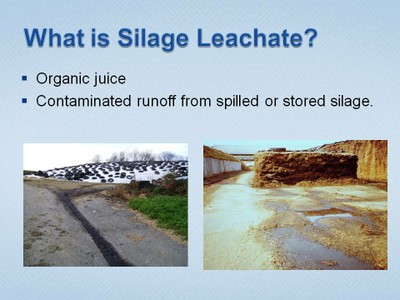
Silage is more than a nutrient-rich livestock feed. Improperly handled, it may also produce a pollutant. The silage making and storing process can result in liquid effluents, or leachate, gases, malodors, undesirable microorganisms, and waste or spoiled silage. Silage leachate itself is the organic juice or sap that is leached or pressed from green chopped silage. The major environmental concern associated with silage leachate is the oxygen depletion that can occur when this leachate enters natural streams. The five-day biological oxygen demand (BOD5) for raw domestic sewage typically ranges between 300 to 400 milligrams per liter (mg/l), but the BOD5 of silage leachate ranges from 12,000 to 90,000 mg/l. Because silage leachate is usually produced in late summer and early fall there is the potential that this high BOD5 liquid can reach streams that are already low in total oxygen because of seasonally high temperatures and seasonally low flow. This webinar provides an overview of silage leachate collection and treatment systems as well as alternative options for dealing with silage leachate.
This webinar is sponsored by the USDA Natural Resources Conservation Service.


 Loading